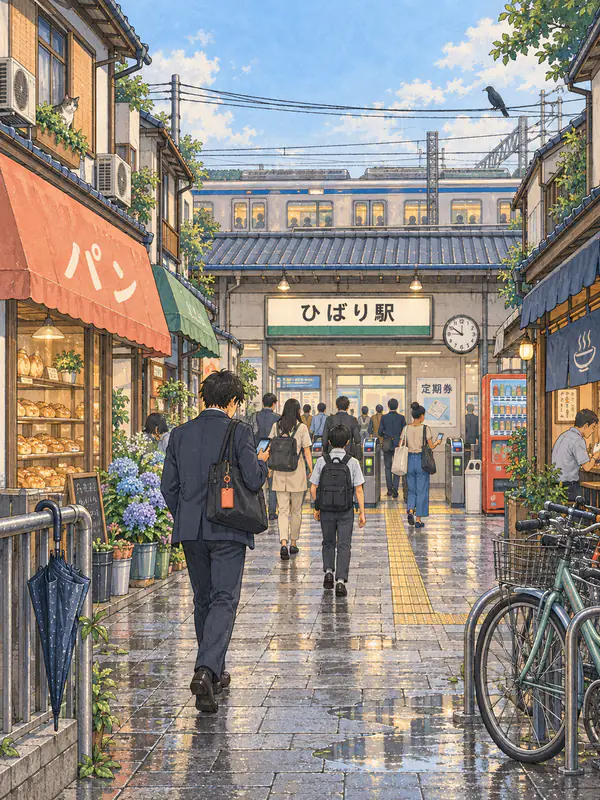
Mobile Suica / PASMORecommended
Set up a digital IC card on your smartphone — no physical card needed.
Download the Suica or PASMO app from the App Store / Google Play
Register and add a payment method (credit card or Apple Pay)
Charge your card and tap your phone at station gates
Physical IC Card
Buy a plastic IC card from a ticket machine or station counter.
Deposit: ¥500 (refundable)
Where to get: JR ticket machines or station service counters (Midori no Madoguchi)
IC Cards Overview
One card per region: pick the one where you live. Each also works in the other regions, but a single trip has to stay inside one IC area.
- ✓Each of the 10 cards works in every IC area in Japan
- ×One trip stays inside one area
 Tokyo / Kanto area
Suica
JR East's IC card, widely used in the Tokyo metropolitan area and compatible nationwide.
 Tokyo / Kanto area
PASMO
Used on Tokyo Metro, Toei Subway, and private railways. Interchangeable with Suica.
 Osaka / Kansai area
ICOCA
JR West's IC card, primarily for the Osaka/Kansai region.
The 7 other cards, by region
 Sapporo
 Nagoya
 Nagoya
 KansaiBilled afterwards, on application
 Kyushu
 Fukuoka
 Fukuoka
× One trip = one IC area: you can't tap in in one area and tap out in another.
Good to know (the gotchas)
Do
- Ride with Mobile Suica/PASMO from day oneDay 1
Works on iPhone and most FeliCa-capable Android phones: no physical card needed.
- Get a commuter pass (定期券) on a daily route15+ days/mo
It usually pays off from there. Compare a 6-month pass against pay-as-you-go.
- Hand your card back when you leave¥500
The deposit on a physical Suica/PASMO is refunded when you return the card.
Don't
- Tap in in one IC area and out in another1 area
The gate rejects it (e.g. entering in the JR East area and exiting in another). For cross-area trips, buy a paper ticket.
- Miss the last train11:30 PM
Most last trains depart between 11:30 PM and midnight. Check schedules to avoid being stranded.
Which transit app for what?
Start from what you need right now.
- Is my train late?Real-time delaysY!Yahoo! Transit
- How much is the fare?IC card and ticket faresY!Yahoo! Transit
- I don't read Japanese yetEnglish interfaceGGoogle Maps
- From the station to the doorWalking directionsGGoogle Maps
- Which platform?Platform number (番線)GGoogle Maps
- How long is this transfer?Transfer walking timesNNAVITIME
Yahoo! Transit is in Japanese only. Google Maps shows the platform number when the timetable data includes it — double-check on the station boards.
Commuter pass (teiki-ken) questions
What is a commuter pass (teiki-ken) in Japan?
A commuter pass (teiki-ken, 定期券) lets you ride as often as you like between two stations you choose, and get on or off at any station in between, for 1, 3 or 6 months. It is loaded on a Suica, PASMO or ICOCA card, or in the Mobile Suica or Mobile PASMO app, and it usually pays off from about 15 days of commuting a month.
How do I buy a commuter pass?
At a station ticket machine that sells commuter passes, at the ticket office (Midori no Madoguchi at JR stations), or in the Mobile Suica or Mobile PASMO app, from 14 days before the first day. You give the two stations, the start date and the length, and your name, date of birth and gender exactly as on your ID: a pass registered with a mistake cannot be reissued if you lose it. A new card carries a ¥500 deposit, refunded when you hand it back.
How do I get a student commuter pass?
A student pass (tsugaku teiki, 通学定期) costs much less, but only covers the route between your home and your school. Ask your school for a commuting certificate (tsugaku shomeisho, 通学証明書) and show it with your student ID when you buy the pass. Not every school qualifies, Japanese language schools included: your school's office can tell you.
Will my employer pay for my commuter pass?
Most companies pay a commuting allowance (tsukin teate, 通勤手当), often the price of a commuter pass on the cheapest route, but no law requires it: check your contract or work rules. For train and bus commuters, the allowance is tax-free up to ¥150,000 a month.
What happens if I ride past my pass section?
Tap in and out with the same card as usual: the gate takes only the fare for the part of the trip outside your pass from your card's balance. If the balance is too low, top up at the fare adjustment machine (norikoshi seisanki) before the exit gate.